



Rubber Hose Knitting Machine Maker
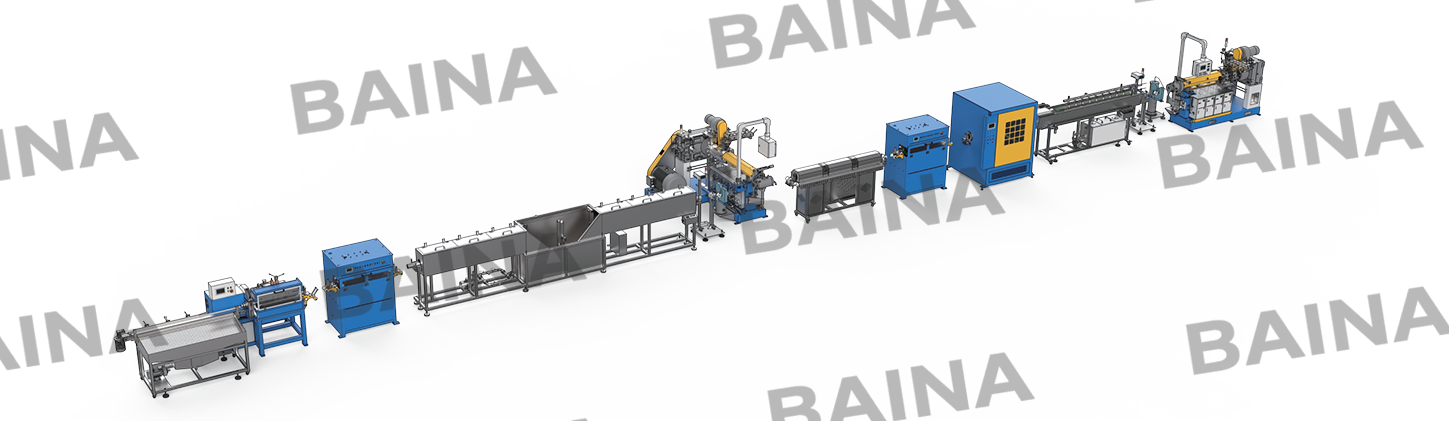
This production line is used for the continuous manufacturing of rubber knitted hoses. Its characteristic is the online knitting of a fiber layer by a high-performance knitting machine after the inner tube is extruded. The line can be configured with a secondary extruder and a hydraulic T-die head for precise outer cover application, achieving one-step composite molding of the "inner rubber - knitted layer - outer rubber" structure. The entire line operates automatically, making it particularly suitable for the mass production of products requiring flexibility and pressure resistance, such as automotive coolant hoses and turbocharger hoses.
Operational Precautions for Rubber Knitting Hose Lines and a Typology of Continuous Vulcanization
Manufacturers of Rubber Knitting Hose Production Lines Share Key Operational Precautions for Rubber Hose Knitting Extrusion Machines
A rubber knitting hose production line combines extrusion (forming the rubber tube), knitting (applying textile reinforcement), and vulcanization (curing the assembly) into a single continuous process. The knitting extrusion machine sits at the heart of this line—it receives the uncured inner tube, guides it through a high-speed knitting head (typically 16–24 carriers), then applies an outer rubber cover before the assembly enters the curing section.
Stage-by-stage precautions from line manufacturers
The following precautions come directly from commissioning reports of rubber hose knitting extrusion machine manufacturers and field failure analyses. They are organized by production stage.
Extruder Feed Zone – Contamination Control
Precaution: Install magnetic grid separators and metal detectors before the feed throat. The knitting section uses small-gauge needles (0.8–1.2mm diameter). A single metal fragment (screw chip, carbon-black agglomerate, or wire bristle) jams a needle, snapping the knitting thread and requiring 45 minutes of re-threading. Search query often missed: how to prevent needle breakage in rubber hose knitting machine – the answer is upstream filtration, not stronger needles.
Inner Tube Dimensional Consistency
Precaution: Use an ultrasonic or laser OD gauge immediately after the inner tube extruder, before the knitting head. Acceptable tolerance: ±0.10mm. Variation larger than ±0.20mm causes uneven knitting tension. The inner tube expands into the needle circle on undersized sections (thread abrasion) and collapses away from needles on oversized sections (missing stitches). Both create weak spots that burst during pressure testing.
Knitting Head Thread Management
Precaution: Store all polyester, nylon, or aramid yarn spools in a humidity-controlled cabinet (45–55% RH). Dry yarn (below 30% RH) becomes brittle and sheds microscopic fibers that accumulate on tension guides. These fibers eventually bind the carriers, causing erratic stitch formation. Field observation: Operators searching for rubber hose knitting machine tension adjustment often find that humidity correction solves the problem before mechanical adjustment is needed.
Outer Cover Extruder – Vacuum Sizing
Precaution: Apply vacuum (0.2–0.4 bar) between the outer cover extruder die and the knitted substrate. Without a vacuum, air trapped between the knit layer and outer rubber causes blisters during vulcanization. The blister rate on lines without vacuum sizing runs 8–12%. With vacuum sizing, below 1%. This is non-negotiable for hydraulic hose applications.
Curing Section Entry – Centering and Anti-Backlash
Precaution: Install a passive centering guide (three-roller cage) immediately before the curing tunnel. The knitted hose has a natural tendency to rotate slightly between the outer extruder and the vulcanizer entry. Rotation twists the reinforcement layer, reducing burst pressure by 15–25% even if the rubber looks fine. The centering guide eliminates rotation.
Post-Cure Cooling and Haul-Off
Precaution: Do not cool the cured hose below 40°C before the belt haul-off. Cooling below 40°C increases the rubber's modulus (stiffness) by 300–400%, requiring higher haul-off tension. That tension stretches the hose, thinning the wall and changing the inner diameter. Maintain a minimum of 45–50°C at the haul-off entry. Search intent: optimum cooling temperature for continuous vulcanized rubber hose addresses this.
What Are the Main Types of Continuous Vulcanization Lines? A Concise and Clear Overview
A continuous vulcanization (CV) line is a curing system integrated directly with an extruder, allowing uncured rubber profiles to enter, travel through a heated zone, and exit as fully crosslinked finished product—without batch processing or manual transfer between stations.
Hot Air Tunnel CV (The Baseline)
Heated air circulates the profile using fans and electric or gas-fired heaters. Temperature range: 180–300°C. Simplest technology, lower capital cost. Trade-off: Slowest line speeds (3–8 m/min for 10mm profiles). Best for thick cross-sections (>15mm) where cure time is already long, or for silicone (which does not absorb microwave energy efficiently). Search query: hot air continuous vulcanization for silicone tubing.
Fluidized Bed CV (Salt Bath or LCM)
The profile passes through a tank of molten salt (typically nitrate/nitrite mixture) or a bed of fine glass beads fluidized by hot air. Salt bath offers the fastest heat transfer (conduction). Line speeds: 15–25 m/min for EPDM. Trade-off: Requires post-cure washing to remove salt residue. Salt bath is unsuitable for silicone (contamination risk) or any food-contact application. Search signal: LCM continuous vulcanization line for high-speed EPDM hose.
Microwave (UHF) + Hot Air Hybrid CV
The profile first passes through a UHF microwave section (915 MHz or 2.45 GHz) that heats volumetrically, then through a short hot air tunnel for thermal equalization. Line speeds: 10–20 m/min, depending on profile thickness. Advantage: No post-cure cleaning required. Works well for co-extruded dense + sponge profiles. Trade-off: Higher initial equipment cost (microwave generators add $50,000–150,000 to a line). Search query: UHF microwave plus hot air vulcanization line for rubber profiles.
Lead Bath CV (Legacy – Phasing Out)
Molten lead (330–450°C) surrounds the rubber hose or profile. Extremely high heat transfer, line speeds up to 40 m/min for small-diameter hose. Major trade-off: Lead toxicity, fume handling requirements, and strict OSHA/EPA regulations in Western markets. New installations are rare. Replacement lines are typically converted to a salt bath or a microwave. Search intent: replacing lead bath continuous vulcanization with lead-free technology.
Quick Selection Guide
Criterion Hot Air Salt Bath (LCM) Microwave+Air Lead Bath
|
Criterion |
Hot Air |
Salt Bath (LCM) |
Microwave+Air |
Lead Bath |
|
Typical line speed (10mm EPDM) |
3–8 m/min |
18–25 m/min |
12–18 m/min |
25–40 m/min |
|
Post-cure cleaning required? |
No |
Yes (water wash) |
No |
Yes (lead removal) |
|
Suitable for silicone? |
Yes |
No |
Poor (low absorption) |
Yes (but toxic) |
|
Capital cost (relative) |
$ |
$$ |
$$$ |
$$ (but high environmental cost) |
|
Regulatory status in EU/US |
Fully approved |
Approved (with wastewater permit) |
Fully approved |
Restricted/banned |
-

-
No. 18, Chunhui Est. Rd., Yong’An Ind. Area, Xianju, Taizhou, Zhejiang, ChinaRoom 707, Building 1, Baolong Plaza, Hangzhou Sci-Tech City, Yuhang District, Hangzhou, Zhejiang, China+86-576-87685299
+86-571-89059793+86-576-87685311 - Home Machinery&Solutions About Baina Industry Applications Support Info Contact Us
-
Copyright © 2025 by Zhejiang Baina Rubber & Plastic Equipment Co., Ltd. All Rights Reserved.

Continuous Vulcanization Line