




Home / Machinery&Solutions / Production Line Series / Silicone Extrusion Production Line / Horizontal Type Silicone Extrusion Production Line
Horizontal Type Silicone Extrusion Production Line Supplier
Baina's horizontal silicone rubber extrusion line employs a mature and reliable horizontal layout with a clear workflow, offering spacious and convenient operation and maintenance access. This line is also equipped with a high-performance silicone extruder and utilizes a combination of horizontal ultra-high-temperature infrared ovens and hot air vulcanization ovens. This provides sufficient preheating and vulcanization time for the silicone, offering broad process adaptability and strong stability.
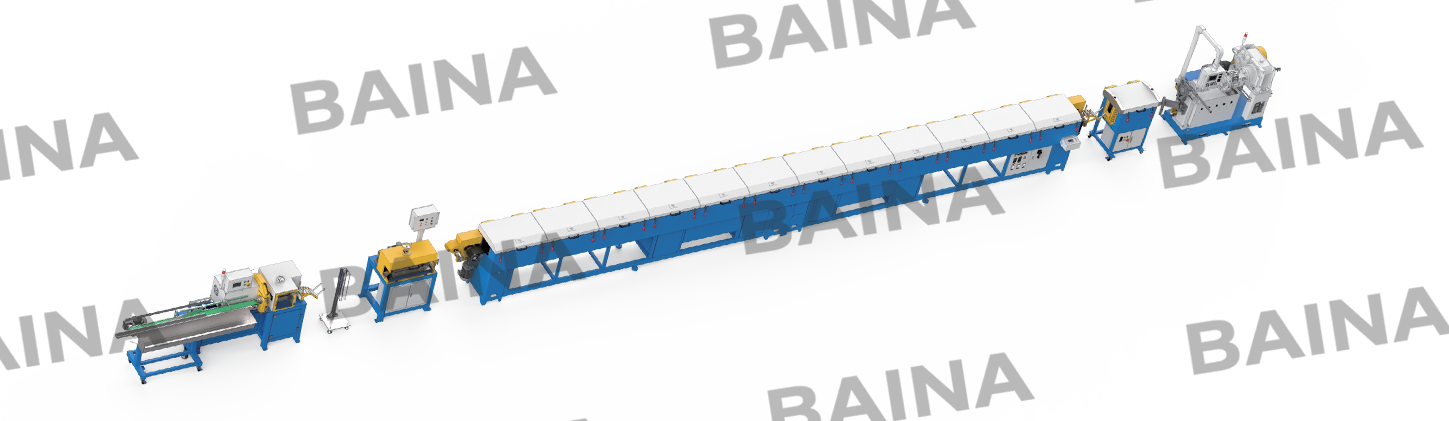
A Technical Breakdown of Horizontal Silicone Extrusion Lines, Applications, and Machine Differences
Components of a Horizontal-Type Silicone Extrusion Production Line
A horizontal-type silicone extrusion production line is a linear configuration of equipment where uncured silicone rubber (high-consistency rubber or liquid silicone rubber) is fed, shaped, vulcanized, and cut along a straight, level path—typically 20–40 meters in total length.
The seven core components in order
Starting from the operator's left and moving to the right across a typical factory floor:
Strip Feeder or Metering Pump
For HCR (high-consistency rubber): a powered roller table accepts a 50–100mm wide silicone strip. For LSR (liquid silicone rubber): a two-part metering pump (A+B components) mixing at a 1:1 ratio enters a static mixer. Search query: LSR metering pump for silicone extrusion line.
Horizontal Extruder (Cold-Feed, Water-Cooled Barrel)
Silicone is heat-sensitive. The extruder barrel has independent water zones (feed zone at 20–30°C, compression zone at 40–50°C, metering zone at 60–70°C). The screw L/D ratio is longer than that of rubber extruders—typically 16:1 to 20:1—to homogenize without overheating.
Die Head and Tooling
Crosshead or straight-flow dies. For tubing: a mandrel supported by three spider legs. The legs leave flow lines, so medical-grade tubing uses a spiral mandrel distributor to eliminate weld marks.
Horizontal Hot Air Vulcanization Tunnel
Length: 6–15 meters. Temperature zones: 150–400°C, increasing from entry to exit. Silicone cures via condensation reaction (no sulfur), requiring no pressure – just heat.
Cooling Section
Ambient air blowers or chilled water spray (for thick profiles >5mm). Silicone exits the oven at 150–200°C and must drop below 60°C before handling.
Puller (Caterpillar or Belt Type)
Servo-driven with tension feedback. Silicone's low tear strength means tension must stay below 50 Newtons for thin tubing.
Servo Cutter or Spooler
Flying knife cutters for lengths up to 2 meters, or planetary winders for continuous coiling.
Silicone Extrusion Machines: Application Areas
A silicone extrusion machine is a specialized extruder (cold-feed, water-cooled barrel, low-shear screw) designed to process high-consistency or liquid silicone rubber into continuous profiles that are then heat-cured in-line. The machine itself does not vulcanize the silicone—it only shapes it.
Where you actually find silicone extrusions in the wild
Silicone extrusion occupies niches where other rubbers fail. The three dominant application areas:
Medical and Pharmaceutical (The Largest Segment)
- Products: Catheters, drainage tubes, peristaltic pump tubing, and bulb seals for drug delivery devices.
- Why silicone: Biocompatible (USP Class VI), can be sterilized by autoclave or gamma radiation, does not support bacterial growth.
- Search query: medical grade silicone tubing extrusion line cleanroom. The line must include HEPA filtration on cooling air, stainless steel product contact surfaces, and validated cleaning protocols between batches.
- Critical spec: Platinum-cured, not peroxide-cured. Peroxide byproducts (benzaldehyde, acetophenone) are cytotoxic.
Automotive Under-Hood Components
- Products: Turbocharger hose connectors, charge air cooler seals, EGR tube gaskets.
- Why silicone: Continuous service at 180–220°C (EPDM maxes at 150°C). Resists oil aging better than natural rubber but worse than FKM (fluoroelastomer) – price sits between them.
- Search intent: high-temperature silicone extrusion for automotive turbo hose. The extrusion line must handle thin walls (1–2mm) without tearing.
Food and Beverage Processing
- Products: Dispensing tubes for dairy fillers, gaskets for sanitary fittings, brewer's hose.
- Why silicone: FDA 21 CFR 177.2600 compliant, non-stick surface, easy to clean with CIP (clean-in-place) chemicals. Low water absorption prevents bacterial harborage.
- Search query: food-grade silicone extrusion line with white pigmentation – white or blue color indicates food contact (black often contains recycled or non-food-grade carbon black).
Silicone Extrusion Applications by Industry
|
Industry |
Typical Product |
Temperature Range |
Key Requirement |
Search Signal |
|
Medical |
Catheter tubing |
Ambient to body temp |
Biocompatibility, platinum cure |
USP Class VI silicone extrusion |
|
Automotive |
Turbo hose |
-40°C to 220°C |
Tear strength, oil resistance |
FVMQ silicone extrusion for fuel contact |
|
Food processing |
Dispensing tube |
-30°C to 150°C |
FDA compliance, non-toxic pigments |
FDA silicone hose extrusion line |
|
Construction |
Gasket for curtain wall |
-40°C to 120°C |
UV resistance, compression set |
weather resistant silicone profile extrusion |
Silicone Extruder Machines vs. Rubber Extruder Machines: What Are the Differences?
The difference between a silicone extruder and a rubber extruder lies primarily in thermal management, screw geometry, and material feeding—not the machine's external appearance. Both are single-screw cold-feed extruders, but the internal design varies significantly.
Barrel Cooling System (The Most Obvious)
- Rubber extruder: Water-cooled only in the feed zone. The compression and metering zones run uncooled or have minimal cooling. Temperature at the die: 80–110°C.
- Silicone extruder: Full-length water cooling. The barrel has independent cooling jackets over every zone. Temperature at the die: 60–80°C. Exceed 90°C, and silicone begins premature crosslinking (scorching) inside the barrel.
- Search query: silicone extruder with zone temperature control vs rubber extruder cooling.
Screw Design (L/D Ratio and Flight Depth)
- Rubber screw: L/D ratio 12:1 to 16:1. Compression ratio 1.2:1 to 1.5:1. Shallow metering section.
- Silicone screw: L/D ratio 16:1 to 20:1. Compression ratio 1.5:1 to 2.0:1. Deeper flights throughout to reduce shear heating. Many silicone screws are double-flighted for more homogeneous output without extra RPM.
- Result: A rubber screw run on silicone will scorch the material within 20 minutes.
Feeding Method
- Rubber: Strip-fed (hand-fed or roller-fed) into an open hopper. Strip thickness 10–15mm.
- Silicone (HCR): Requires a powered nip roller feeder with an adjustable gap. Silicone strip is softer and stickier than rubber; it will not gravity-feed reliably.
- Silicone (LSR): Metering pump, not a screw feeder. Two liquid components mix at the pump, enter a static mixer, then feed into the extruder screw or directly into the die.
Die Swell Behavior
- Rubber die swell: 15–30% linear expansion after exiting the die.
- Silicone die swell: 5–10% maximum. Silicone flows more like a Newtonian fluid. This means the die dimensions are closer to final product dimensions—no need to heavily undersize the die.
Silicone vs. Rubber Extruder Features
|
Feature |
Silicone Extruder |
Rubber Extruder |
|
L/D ratio |
16:1 to 20:1 |
12:1 to 16:1 |
|
Barrel cooling |
Full-length water jackets |
Feed zone only |
|
Max barrel temperature |
80°C |
110°C |
|
Screw compression ratio |
1.5:1 to 2.0:1 |
1.2:1 to 1.5:1 |
|
Feeding method |
Powered nip roller or pump |
Gravity or roller-assisted strip |
|
Die swell |
5–10% |
15–30% |
|
Vulcanization downstream |
Hot air (no pressure required) |
Hot air, UHF, salt bath, or steam |
|
Search query example |
silicone HCR extruder with water-cooled barrel |
cold feed rubber extruder for EPDM profiles |
-

-
No. 18, Chunhui Est. Rd., Yong’An Ind. Area, Xianju, Taizhou, Zhejiang, ChinaRoom 707, Building 1, Baolong Plaza, Hangzhou Sci-Tech City, Yuhang District, Hangzhou, Zhejiang, China+86-576-87685299
+86-571-89059793+86-576-87685311 - Home Machinery&Solutions About Baina Industry Applications Support Info Contact Us
-
Copyright © 2025 by Zhejiang Baina Rubber & Plastic Equipment Co., Ltd. All Rights Reserved.

Silicone Extruder Machine