



Home / Machinery&Solutions / Production Line Series / Rubber Single Extrusion And Curing Production Line
Rubber Extrusion Production Line
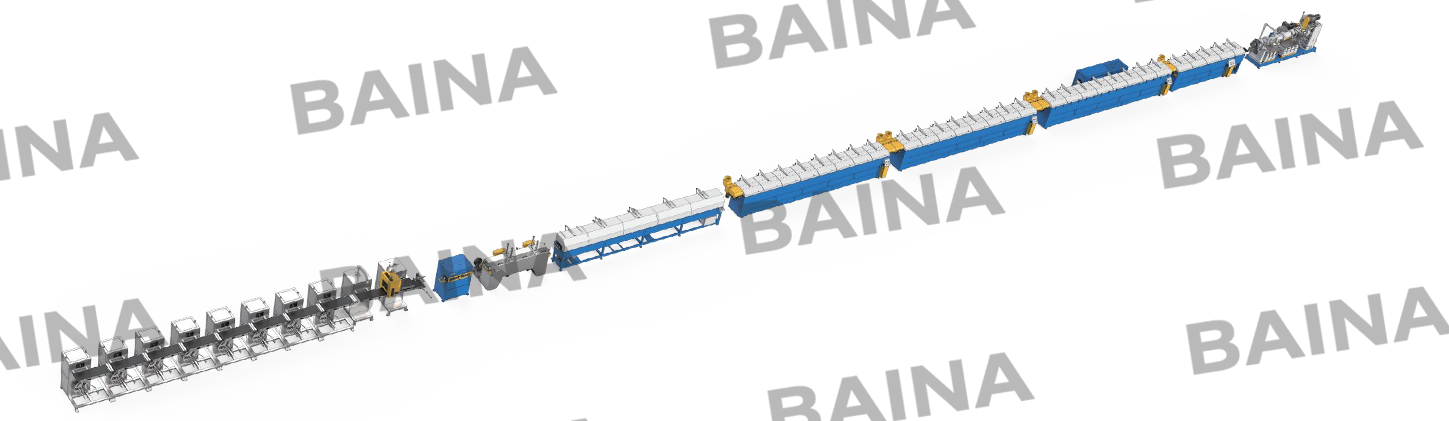
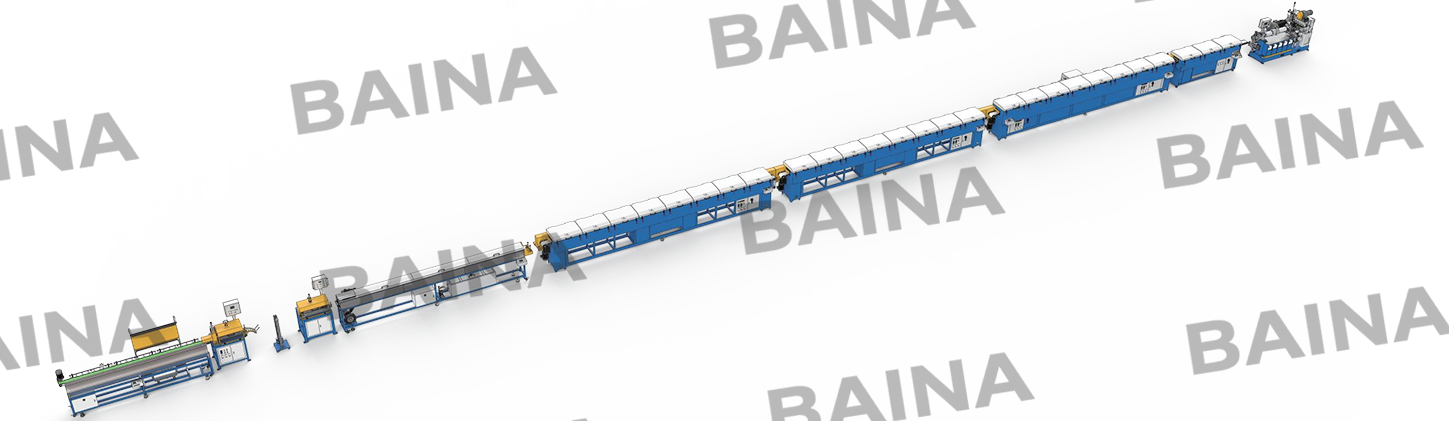
The rubber single extrusion vulcanization production line is a highly efficient production system integrating extrusion molding and continuous vulcanization, serving as the core solution for the efficient, continuous production of rubber profile products. It seamlessly integrates extrusion molding with continuous vulcanization processes, specifically designed for the mass production of products such as automotive sealing strips, hoses, and solid rubber strips made from a single rubber compound.
The Cure at the End of the Line: Understanding the Pneumatic Vulcanizing Machine's Role and What Determines Its Price
What Role Does the Automatic Pneumatic Vulcanizing Machine Play Within a Rubber Extrusion Production Line?
An automatic pneumatic vulcanizing machine is a continuous or batch curing device that uses compressed air-actuated pressure and controlled heat to crosslink extruded rubber profiles after they leave the extruder die.
Where it sits and what it actually does
The rubber extrusion line follows a strict sequence: extruder → cooling tank (optional) → vulcanization → puller/cutter. The pneumatic vulcanizer occupies the critical transition between shaped but uncured rubber and finished elastic product.
Think of the extruder as the sculptor giving form to wet clay. The vulcanizing machine is the kiln. Without it, the extruded profile remains thermoplastic—it will deform under heat, dissolve in solvents, and permanently compress under load.
Step 1 – Receiving the green extrudate: Uncured rubber (called "green" or "raw" profile) enters the vulcanizer's heated chamber. Temperature typically ranges from 150°C to 200°C depending on the compound—EPDM rubber cures best around 160–180°C; silicone requires higher, 170–210°C.
Step 2 – Pneumatic pressure application: Compressed air (usually 4–6 bar) activates clamping cylinders that press the profile against heated platens or into a jaw channel. The pneumatic response is immediate—typically 0.3–0.5 seconds to full pressure—faster than hydraulic equivalents.
Step 3 – Dwell time execution: The rubber stays under heat and pressure for a preset duration (30 seconds to several minutes per batch, or continuously at line speed for tunnel-style units). During this window, sulfur or peroxide crosslinks form between polymer chains. The material transitions from sticky and deformable to elastic and stable.
Step 4 – Cool-down and release: Post-cure, the machine vents steam or hot air, and pneumatic cylinders retract. Some units include built-in cooling fans to drop profile temperature below 60°C for dimensional stability.
Where you absolutely need a pneumatic vulcanizer
Continuous weatherseal production: Automotive door seals running at 5–15 meters per minute. Pneumatic conveyorized hot air tunnels maintain uniform cure without stopping the line.
- Molded connector boots (batch process): A pneumatic press with multi-cavity tooling cures 20–50 small parts simultaneously. The fast cycle time (45–60 seconds) keeps labor costs contained.
- Sponge rubber profiles: Closed-cell EPDM foam requires precise pressure control during expansion. Pneumatic systems modulate pressure in real-time; hydraulic units overshoot.
Pneumatic vs. Hydraulic vs. Hot Air Tunnel Vulcanizers
|
Feature |
Automatic Pneumatic |
Hydraulic Press |
Hot Air Tunnel (Continuous) |
|
Pressure response speed |
Very fast (0.3–0.5s) |
Moderate (1–2s) |
Not applicable (no clamping) |
|
Cleanliness |
Excellent (no oil) |
Poor (leak risk near rubber) |
Excellent |
|
Best application |
Small-to-medium profiles, sponge rubber |
Thick sections, large molded parts |
Long continuous profiles (seals, tubing) |
|
Typical output format |
Batch or semi-continuous |
Batch only |
Continuous coil |
|
Search signal |
pneumatic vulcanizing press for EPDM sponge |
hydraulic rubber vulcanizing press for large gaskets |
hot air vulcanization tunnel for extruded silicone |
An automatic pneumatic vulcanizing machine is not optional on a serious rubber extrusion line. It is the step that transforms extruded shape into functional rubber.
What Factors Typically Influence the Price of a Hot Vulcanizing Machine?
A hot vulcanizing machine (whether pneumatic, hydraulic, or continuous) is capital equipment priced according to thermal capacity, pressure control precision, automation level, and downstream integration requirements. Prices range from 8,000forabasicbenchtoppneumaticpressto8,000forabasicbenchtoppneumaticpressto250,000+ for a fully automated continuous tunnel with PLC controls.
Press Platen Size and Thermal Uniformity
Larger platens cost exponentially more, not linearly. A 300x300mm platen set might cost 2,000.A600x600mmsetcosts2,000.A600x600mmsetcosts8,000–10,000. Why? Maintaining ±2°C temperature variation across a larger surface requires more heating zones (typically one cartridge heater per 100x100mm zone) and thicker tool steel to distribute heat. Search query: large format hot vulcanizing press with zone temperature control.
Heating Technology
Cartridge heaters (budget): $8,000–25,000 machines. Slower heat-up (20–30 minutes). Acceptable for low-volume shops.
Embedded cast-in heaters (mid-range): $25,000–60,000. Faster (10–15 minutes), better uniformity.
Oil circulation heating (high-end): $60,000–150,000. Excellent uniformity (±1°C), used for medical-grade silicone. Search signal: oil-heated vulcanizing press for silicone rubber curing.
Downstream Integration Requirements
A standalone press costs less. A machine designed to sync with an upstream extruder puller and a downstream cutter adds $15,000–40,000 for synchronized PLC control, encoder feedback, and line speed matching.
|
Application Tier |
Key Features Included |
Search Query Example |
|
Entry-level / Repair shop |
Manual or semi-auto, 300x300mm platens, cartridge heat, no data logging |
small hot vulcanizing press for rubber gasket repair |
|
Mid-range / Small manufacturer |
Pneumatic or hydraulic, 400x400mm, closed-loop pressure control, basic recipe storage |
automatic rubber vulcanizing machine for EPDM profiles |
|
High-end / Automotive supplier |
600x600mm+, oil heating, multi-zone uniformity, full data logging, part traceability |
precision hot vulcanizing press with cure data export for automotive seals |
|
Continuous tunnel (for extrusion lines) |
Hot air or microwave assist, variable speed conveyor, integrated cooling zone |
continuous vulcanization tunnel for extruded silicone tubing |
The unseen cost: Shipping and installation. A 2,000 lb press requires a certified rigger to move it. Forgetting this is why first-time buyers exceed budget.
Final rule of thumb: Search for used hot vulcanizing machine for sale if your tolerance requirement is ±0.5mm or looser. Buy new only when you need documented ±0.1mm repeatability for certified production.
-

-
No. 18, Chunhui Est. Rd., Yong’An Ind. Area, Xianju, Taizhou, Zhejiang, ChinaRoom 707, Building 1, Baolong Plaza, Hangzhou Sci-Tech City, Yuhang District, Hangzhou, Zhejiang, China+86-576-87685299
+86-571-89059793+86-576-87685311 - Home Machinery&Solutions About Baina Industry Applications Support Info Contact Us
-
Copyright © 2025 by Zhejiang Baina Rubber & Plastic Equipment Co., Ltd. All Rights Reserved.

Automatic Pneumatic Vulcanizing Machine