




Home / Machinery&Solutions / Production Line Series / Rubber Single Extrusion And Curing Production Line / Rubber Single Extrusion And Curing Production Line(UHF+HAV)Std.Ver
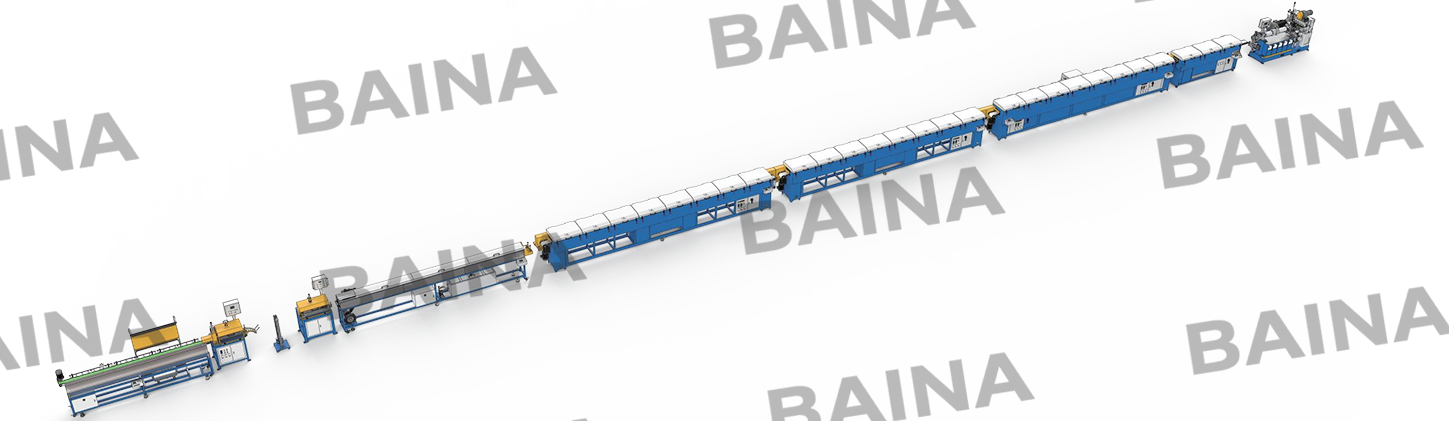
Extruder Machine For Rubber Factory
BAINA single extrusion line integrates a high-performance cold-feed extruder with an advanced "Microwave (UHF) + Hot Air (HAV)" composite vulcanization system, achieving full-process automation from extrusion to finished product. Microwave technology ensures rapid and uniform heating of the rubber compound internally, significantly improving vulcanization efficiency and energy savings.
Staying Alive and Online: A Guide to Rubber Extruder Operation, Maintenance, and the CCV Line Advantage
Extruder Machine For Rubber: Operation and Maintenance
A rubber extruder machine is a screw-driven continuous pumping system that transforms uncured rubber compound (strip, slab, or pellet form) into a shaped profile by forcing it through a die under controlled temperature and pressure. Unlike plastic extruders that melt the material, rubber extruders only soften and plasticize while keeping the compound below its cure temperature.
The daily rhythm of run, clean, and inspect
Operating and maintaining a rubber extruder follows a predictable cycle. New operators search for rubber extruder machine operation checklist; veterans know the real document is called "what broke last Tuesday."
Operation – The start-up ritual
- Pre-heat the barrel and screw: Set temperature controllers to 60–80°C for most compounds (EPDM, NR, SBR). Butyl runs cooler, 50–60°C. Silicone needs 80–100°C. Cold-starting a rubber extruder with compound in the barrel will shear the material into an unmovable plug. The symptom: The motor draws amps but the screw does not turn. The fix: Heat for 45 minutes and pray.
- Feed strip preparation: The strip width should be 60–80% of the feed hopper opening. Too narrow: bridging (air pockets). Too wide: jamming at the throat. Search for rubber extruder feed strip bridging solutions returns advice about adding a powered roller feeder.
- Die alignment and startup: Crack the die bolts slightly (finger-tight plus one quarter turn). Start the screw at 5–10 RPM. As rubber exits, tighten bolts in a star pattern. Never start with a fully tightened die—pressure spikes blow the die face off.
Maintenance – The non-negotiable intervals
- Daily (every shift): Remove the die and screw tip. Scrape cured rubber from the breaker plate. Cured particles left in place will tear the next profile's surface. Search query: how to clean rubber extruder screw without damaging flights – answer: use soft brass scrapers, never steel.
- Weekly: Pull the screw. Inspect flight edges for wear. A worn flight has a rounded rather than square profile. Reject when the flight height decreases by more than 2mm from original.
- Monthly: Check the water-cooled feed zone. Scale buildup inside water jackets reduces cooling, allowing premature scorch. Descale with phosphoric acid solution (20% concentration, circulate for 4 hours).
- Annually: Replace the barrel liner if the internal diameter has increased by 0.5mm or more. Worn barrel + worn screw = exponential output loss. The rule of thumb: 0.1mm barrel wear reduces output by 8–10%.
Common failure pattern – The cold feed zone trap
Operators searching for rubber extruder scorch at the feed throat discover that the water-cooled feed zone (which prevents premature curing) needs a specific water flow rate – typically 10–15 liters per minute. Below that, the feed section creeps above 70°C, and sulfur accelerators activate. Above that, condensation forms on the inside barrel wall, making the rubber slip instead of conveying.
Rubber vs. Plastic Extruder Maintenance
|
Maintenance Task |
Rubber Extruder |
Plastic Extruder |
|
Screw pull frequency |
Weekly to monthly |
Every 3–6 months |
|
Primary wear mechanism |
Abrasion (carbon black) |
Corrosion (acidic byproducts) |
|
Post-shutdown cleaning |
Manual scraping (cured rubber) |
Purge compound (heat degradation) |
|
Die change time |
15–30 minutes (bolt-on) |
5–10 minutes (clamp system) |
|
Operator search term |
rubber extruder screw removal tool |
plastic extruder purge compound temperature |
Operator search term rubber extruder screw removal tool plastic extruder purge compound temperature
What Are the Characteristics of the Catenary Continuous Automatic Vulcanization CCV Line?
The Catenary Continuous Vulcanization (CCV) line is a specialized curing system for rubber-insulated electrical cable and hose. The extruded product hangs in a free loop (catenery curve) as it passes through a long vertical or inclined steam-heated tube—typically 300–600 meters in length. The catenary shape centers the product within the tube, preventing contact with the walls before the rubber is fully cured.
how does a catenary continuous vulcanization line prevent cable sag during rubber curing
The characteristic that defines CCV is the self-centering behavior of a freely hanging curve. In a vertical CCV tower (30–50 meters tall), the cable enters from the top extruder, drops vertically through a steam tube, then exits at ground level. The natural catenary shape—the same curve as a hanging chain—keeps the cable exactly in the tube's center. No mechanical guides touch the uncured rubber. No guide marks. No eccentric wall thickness.
For horizontal CCV lines (inclined at 5–15 degrees), the catenary curve shifts to the lower side. The product rests on a cushion of steam rather than on rollers. This is critical for large-diameter cable (up to 150mm OD), where gravity would otherwise flatten the uncured rubber against any guide surface.
catenary CV line steam tube temperature control for thick rubber insulatio
The second key characteristic is thermal zoning. A typical CCV steam tube divides into 4–8 independent heating zones. Zone 1 (entry) runs at 160–180°C to quickly set the outer skin. Zones 2–5 ramp to 200–220°C to cure the bulk insulation. Zones 6–8 cool gradually to 100–120°C before exit. The gradient prevents steam blistering (moisture trapped inside the insulation flashing to steam and creating bubbles).
Where CCV outperforms all alternatives
Medium-voltage power cable (5–35 kV) – The insulation layer (typically XLPE or EPDM) must have perfectly concentric thickness. Eccentricity over 5% fails IEEE testing. CCV achieves 2–3% eccentricity because the catenary curve eliminates off-center forces. A salt bath line or horizontal hot air tunnel would require mechanical centering guides that inevitably push the core off-center.
Rubber hose with textile braid reinforcement – A 25mm ID hydraulic hose enters the CCV tube immediately after braiding. The steam penetrates the braid openings and cures the inner tube and outer cover simultaneously. No separate autoclave step.
Low-green-strength compounds – butyl or chloroprene – These tear easily under tension. CCV's free-hanging design applies minimal tension—just enough to overcome steam drag (approximately 5–10 Newtons). A horizontal puller-type line would require 50–100 Newtons, which would stretch and tear the butyl inner liner.
-

-
No. 18, Chunhui Est. Rd., Yong’An Ind. Area, Xianju, Taizhou, Zhejiang, ChinaRoom 707, Building 1, Baolong Plaza, Hangzhou Sci-Tech City, Yuhang District, Hangzhou, Zhejiang, China+86-576-87685299
+86-571-89059793+86-576-87685311 - Home Machinery&Solutions About Baina Industry Applications Support Info Contact Us
-
Copyright © 2025 by Zhejiang Baina Rubber & Plastic Equipment Co., Ltd. All Rights Reserved.

Automatic Vulcanizing Machine