




Insulation Pipe/Sheet Production Line Factory
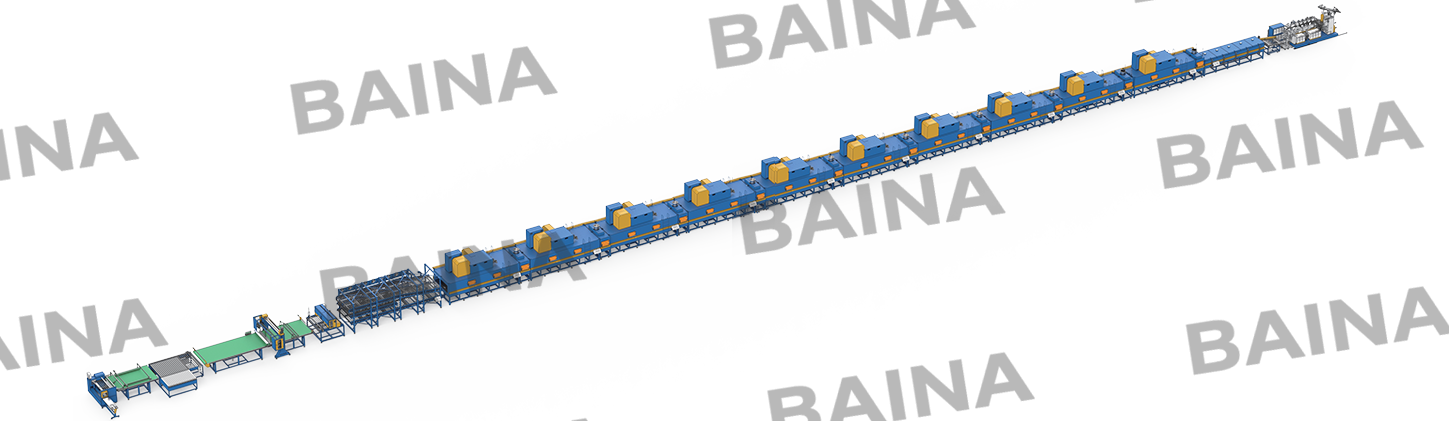
Specifically designed for producing foamed vulcanization lines of rubber/plastic insulation materials such as NBR/PVC and EPDM. It utilizes multi-section hot air foaming ovens with different widths for precise temperature control, ensuring uniform and fine cell structure and excellent insulation performance. The line features a flexible design, allowing quick switching between producing insulation pipes and boards by changing the die head. It also integrates complete cooling, edge trimming, cutting, and collection systems.
Insulation Pipe and Sheet Lines Industry Knowledge Extension
Insulation Pipe/Sheet Production Line
An insulation pipe and sheet production line is a continuous manufacturing system that converts rubber compounds—typically EPDM, NBR, or chloroprene—into closed-cell foam sheets or tubular pipe insulation. The line integrates mixing, extrusion or calendering, expansion, vulcanization, and cutting into a single flow.
How the line handles two different product families
Despite sharing the same compound recipes, pipe and sheet insulation require fundamentally different forming sections. Manufacturers searching for insulation pipe production line vs sheet line often discover that combining both on one platform requires modular changeover kits.
Pipe forming on the same line uses two primary methods:
- Extrusion molding with mandrel support: A tube extruder pushes the foamable compound through an annular die. A fixed mandrel (water-cooled center pin) maintains the internal diameter while the external diameter expands in the hot air vulcanization tunnel. Typical pipe lengths: 1–2 meters, cut post-cure.
- Wrap forming (semi-continuous): A calendered sheet wraps around a rotating cylindrical mandrel. Seams are butt-welded with heated rollers before the wrapped tube enters the cure oven. This method produces larger-diameter insulation (4–12 inches ID) that cannot be extruded directly.
Sheet forming dominates for flat products:
- Calendering: Three or four stacked rollers compress the foamable compound into precise sheet thickness (3–50mm). Calendered sheets have smoother surfaces than extruded sheets, critical for HVAC duct liner where air friction matters.
- Extrusion through a coat-hanger die (wide slot die): Produces sheet widths up to 2,000mm. The trade-off: extrusion lines run faster (8–12 m/min) but require more floor space than calenders.
Pipe vs. Sheet Line Priorities
|
Parameter |
Pipe Insulation Line |
Sheet Insulation Line |
|
Primary forming method |
Extrusion with mandrel or wrap |
Calendering or slot die extrusion |
|
Typical product dimensions |
6–114mm ID, 10–50mm wall |
3–50mm thickness, 1,000–2,000mm width |
|
Post-forming step |
Slitting or longitudinal cutting |
Die-cutting or rotary slitting |
|
Search query for suppliers |
continuous pipe foam extrusion line for HVAC |
rubber sheet calendering line with embossing |
Forming and Processing Equipment – Pipe Forming and Sheet Forming
Forming equipment shapes uncured rubber into a defined geometry before vulcanization. The method chosen determines dimensional accuracy, surface finish, and line speed.
Pipe Forming – Two Dominant Technologies
Spiral Winding (Large Diameter, Low Volume)
- Process: A narrow rubber strip (50–100mm wide) winds helically around a rotating mandrel at a controlled pitch. Layer overlays itself, fusing during winding. Used for large-diameter flexible ducting (150–400mm) where an extruded die would be impractically large.
- Equipment needed: Winding lathe with pitch control, strip feeder, and pressure roller.
- Search query: spiral winding rubber hose making machine for large diameter duct
- Trade-off: Slower (1–3 m/min) but lower die costs. Ideal for custom or short-run pipe insulation.
Extrusion Molding (Small to Medium Diameter, High Volume)
- Process: A screw extruder forces compound through an annular die (tube die). The internal diameter is set by a center mandrel suspended by spider legs or a spiral mandrel distributor. Crosshead dies allow the internal mandrel to be supported without flow marks.
- Critical adjustment: Die swell compensation. Rubber expands 15–30% exiting the die. The mandrel must be undersized accordingly. Common search: rubber pipe extrusion die swell calculation method.
- Best for: Continuous lengths of 19–114mm ID pipe insulation.
Sheet Forming – Two Competing Approaches
Calendering (Precision Thickness, Wide Width)
- Process: An inverted L or Z-type calendar (three or four counter-rotating heated rolls) reduces a rubber slab to a uniform sheet. The gap between the last two roll sets final thickness. Typical tolerance: ±0.1mm for a 3mm sheet, ±0.5mm for a 25mm sheet.
- Application: High-volume EPDM roofing membrane, floor underlayment, or dense sheet gasketing.
- Search signal: four-roll calendar for EPDM sheet with automatic gauge control
Slot Die Extrusion (High Speed, Variable Width)
- Process: A gear pump feeds a wide, flat die (coat-hanger or fish-tail design) that distributes compound uniformly across the width. The extrudate exits as a continuous sheet and passes through a three-roller stack for thickness refining.
- Advantage over calendering: Faster width changes. Calendering requires roll grinding to change product width; slot dies swap the die body (30 minutes) instead of regrinding rolls (8 hours).
- Search query: slot die rubber sheet extrusion line for geomembrane
Pipe and Sheet Forming Methods
|
Product Type |
Forming Method |
Typical Line Speed |
Thickness/Diameter Tolerance |
Best Use Case |
|
Pipe (small ID) |
Extrusion molding |
6–12 m/min |
±0.3mm ID |
Mass production, closed-cell foam |
|
Pipe (large ID) |
Spiral winding |
1–3 m/min |
±1.0mm ID |
Custom diameters, short runs |
|
Sheet (thin, 1–5mm) |
Slot die extrusion |
12–20 m/min |
±0.1mm |
High-speed roofing membrane |
|
Sheet (thick, 10–50mm) |
Calendering |
3–8 m/min |
±0.5mm |
Insulation foam, gym mats |
The Function of a Rubber Plate Vulcanizing Machine in Rubber Extrusion
A rubber plate vulcanizing machine is a batch or semi-continuous press that applies heat (typically 140–180°C) and pressure (10–30 kg/cm²) to uncured rubber sheets or extruded profiles, initiating crosslinking. Within an extrusion context, it serves as the final curing station after the extruder has shaped the compound.
Two distinct roles in extrusion lines
Post-extrusion curing for sheet profiles. When an extruder produces wide sheet through a slot die, the sheet cannot pass through a conventional hot air tunnel (uneven curing due to thickness variation). Instead, it feeds directly into a heated platen press with multiple daylight openings. Each press cycle (3–8 minutes) cures a 2-meter sheet length. Search query: rubber sheet vulcanizing press for extruded EPDM membrane.
Alternative to continuous vulcanization for short profiles. For extruded shapes under 3 meters total length (e.g., custom gaskets or small matting), building a CV line is uneconomical. Operators slug-cut the extrudate into blanks, place them into a compression mold, and cure them in a plate vulcanizer. Trade-off: Slower (batch) but lower capital cost than a microwave tunnel.
What Is EPDM Profile Extrusion?
EPDM profile extrusion is the continuous process of shaping uncured EPDM (ethylene propylene diene monomer) rubber into a specific cross-sectional form—such as a weatherstrip, window gasket, or bulb seal—using a screw extruder and a custom die, followed by in-line vulcanization.
Why EPDM dominates this application
EPDM accounts for approximately 70% of all extruded rubber profiles in the construction and automotive sectors. The reasons trace to three material properties: exceptional ozone resistance (outdoor lifespan 10–20 years), wide service temperature (-40°C to 150°C), and compatibility with sponge/blowing agent formulations for cellular seals.
The extrusion workflow for EPDM profiles:
- Feed: Strip-fed (cold feed) extruder with water-cooled feed zone (prevents premature scorch). L/D ratio typically 12:1 to 16:1.
- Die shaping: The profile die is cut from hardened tool steel. For co-extruded profiles (dense base + sponge lip), two extruders feed a single multi-port die head.
- Curing: Almost always continuous vulcanization. Options include: hot air (slow, cheap), microwave + hot air hybrid (fast, clean), or salt bath (fastest, requires post-wash). Search query: best curing method for EPDM weatherstrip extrusion – industry consensus favors microwave hybrid.
- Downstream: Cooling tank (water or forced air), laser micrometer for profile dimension check, and servo-driven cutter.
Use cases you encounter daily: The black rubber seal around your car door, the bulb-shaped gasket at the bottom of a garage door, the glazing channel holding window glass.
-

-
No. 18, Chunhui Est. Rd., Yong’An Ind. Area, Xianju, Taizhou, Zhejiang, ChinaRoom 707, Building 1, Baolong Plaza, Hangzhou Sci-Tech City, Yuhang District, Hangzhou, Zhejiang, China+86-576-87685299
+86-571-89059793+86-576-87685311 - Home Machinery&Solutions About Baina Industry Applications Support Info Contact Us
-
Copyright © 2025 by Zhejiang Baina Rubber & Plastic Equipment Co., Ltd. All Rights Reserved.

Rubber Plate Vulcanizing Machine