



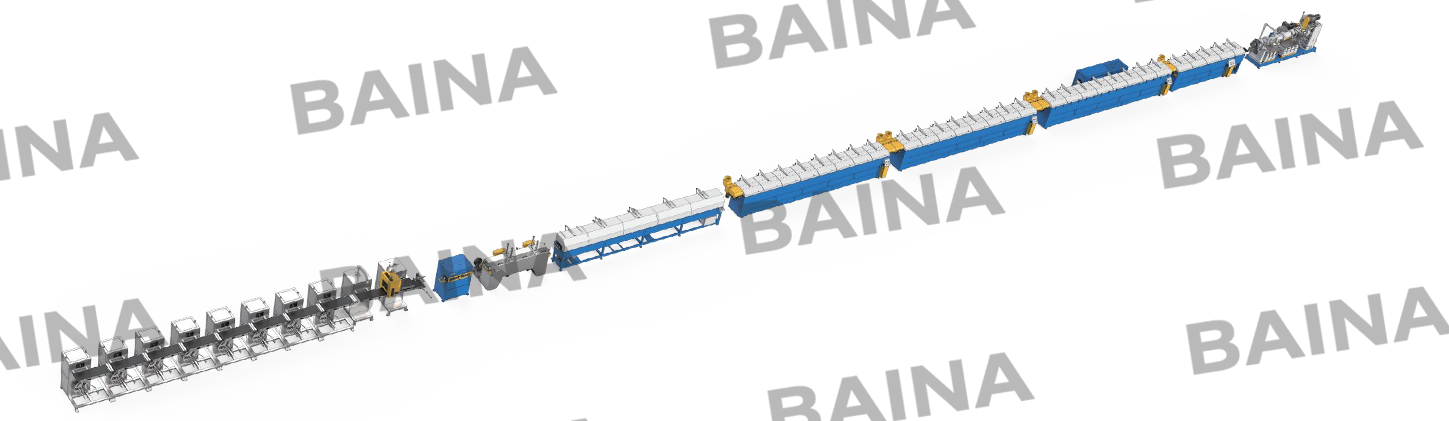
Home / Machinery&Solutions / Production Line Series / Rubber Single Extrusion And Curing Production Line / Rubber Single Extrusion And Curing Production Line(UHF+HAV)EXP.Ver
Rubber Extrusion Company
The high-end version employs top-tier configurations such as Siemens control systems and infrared ultra-high-temperature sizing ovens, specifically designed for products like sealing strips and hoses with stringent requirements for dimensional stability and production efficiency.
Single Screw Rubber Extruders: Technical Updates, Manufacturer Selection, and Cost Considerations
Technical Updates for Single Screw Rubber Extruders
Single screw rubber extruders have been around for decades. But the machines shipping today look very different from those built in the 1990s. The updates focus on three areas: temperature control, energy efficiency, and process monitoring.
Screw geometry optimization
Finite element analysis changed the screw design. Instead of relying on rules of thumb, modern single-screw rubber extruders use screws modeled for specific compounds. The feed section depth, compression ratio, and mixing section geometry come from simulation data. The result: output increases of 15–25% without increasing screw speed. Energy consumption per kilogram drops because the screw does less unnecessary work on the compound.
Vacuum-assisted feed sections
Air trapped in rubber compound causes porosity in the extruded profile. Old machines ran the extruder and hoped the air would escape. New single screw rubber extruders include a vacuum port in the feed barrel section. A vacuum pump pulls 0.6–0.8 bar suction. Entrapped air releases before the compound reaches the compression zone. The finished extrusion has zero pinholes or blisters. For hose and profile applications, vacuum feed has become the expected standard, not a premium option.
Automated die centering systems
Adjusting the die concentricity used to mean loosening bolts, tapping with a mallet, and checking with a caliper. Newer single screw rubber extruders include motorized die adjustments. The operator pushes a button on a screen. Servo motors shift the die in 0.01mm increments. A vision system or laser sensor confirms the position. Changeovers that took an hour now take ten minutes.
Comparison of older vs newer extruder features
|
Feature |
1990s extruder |
Modern single screw rubber extruder |
|
Temperature control |
On-off water spray |
PID closed-loop fluid cooling |
|
Die centering |
Manual bolts and mallet |
Motorized with vision feedback |
|
Vacuum degassing |
None or crude vent port |
Vacuum pump with 0.8 bar suction |
|
Energy metering |
No |
kW per kg displayed live |
|
Typical output for 90mm screw |
~300 kg/hr |
~380 kg/hr |
The updates pay for themselves. A modern single screw rubber extruder running two shifts per day produces roughly 30% more usable extrusion than an equivalent older machine. The compound goes further. The scrap rate drops. The operator spends less time fighting temperature swings and more time supervising the line.
Baina Rubber Extrusion Machine Company: Offering Users Superior Choices
Baina has built a reputation in the rubber extrusion equipment space by doing something unusual: offering multiple lines of machines rather than a one-size-fits-all product. A buyer looking for a basic cold feed extruder finds that. A buyer needing a high-output pin barrel machine for sticky compounds finds that too.
The cold feed series
Baina's cold feed single screw rubber extruders target general-purpose rubber processing. The screw design favors consistent output over maximum speed. Barrel cooling uses water jackets with PID control. The control panel is straightforward—temperature setpoints, screw speed, haul-off coordination. These machines run EPDM, natural rubber, and neoprene compounds reliably.
The pin barrel series
For sticky compounds like silicone or high-carbon black EPDM, Baina offers pin barrel extruders. The radial pins projecting into the screw channels prevent material slip. Output runs 15–20% higher than a smooth barrel machine of the same screw diameter. The pin barrel series also includes deeper barrel cooling channels. Silicone extrusion, which demands tight temperature control, runs consistently on these machines. Buyers processing difficult compounds consistently choose this series.
The vacuum series
For extrusion lines where porosity cannot be tolerated—medical tubing, food contact hose, high-pressure hydraulic hose—Baina's vacuum extruders include a vented barrel section connected to a vacuum pump. The vacuum pulls entrapped air and volatiles out of the compound before the final metering zone. The difference between vacuum-extruded and non-vacuum extruded hose is visible under a microscope. Pinholes disappear. Tensile strength increases because the cross-section is solid rubber, not rubber with microscopic air bubbles.
Rubber Extruder Machine Pricing: Is the Rubber Extrusion Process Expensive?
The question of cost comes up in every equipment purchasing discussion. Rubber extruder machine pricing varies widely. But asking whether the rubber extrusion process is expensive misses the point. The question should be: expensive compared to what? Compared to injection molding? Compression molding? Buying pre-made hose from a supplier?
A new single screw rubber extruder with basic controls and a 60–90mm screw typically runs between 40,000 and 120,000 depending on the brand and features. Pin barrel designs add 20–30%. Vacuum systems add another 15–25%.
Those numbers sound large. But compare them to injection molding presses of similar output capacity. A 500-ton injection molding press with auxiliary equipment costs 200,000–200,000–400,000 and produces one part per cycle. A rubber extrusion line runs continuously, producing kilometers of product per shift. The extrusion process is significantly less capital-intensive per unit of output
-

-
No. 18, Chunhui Est. Rd., Yong’An Ind. Area, Xianju, Taizhou, Zhejiang, ChinaRoom 707, Building 1, Baolong Plaza, Hangzhou Sci-Tech City, Yuhang District, Hangzhou, Zhejiang, China+86-576-87685299
+86-571-89059793+86-576-87685311 - Home Machinery&Solutions About Baina Industry Applications Support Info Contact Us
-
Copyright © 2025 by Zhejiang Baina Rubber & Plastic Equipment Co., Ltd. All Rights Reserved.

Single Screw Rubber Extruder Supplier