



Home / Machinery&Solutions / Production Line Series / Silicone Extrusion Production Line / Vertical Type Silicone Extrusion Production Line
Vertical Type Silicone Extrusion Production Line
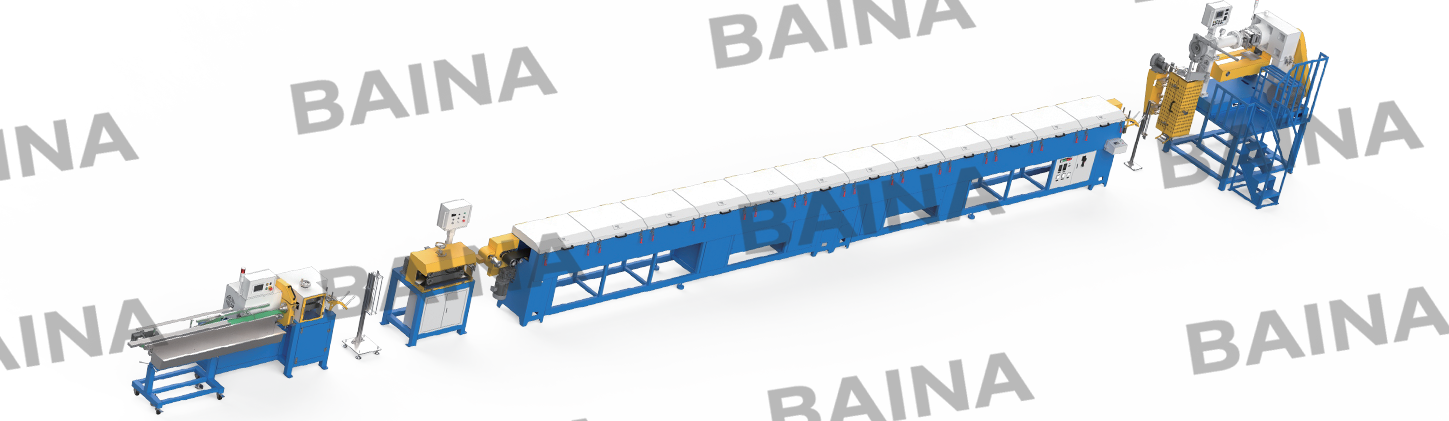
Baina's vertical silicone rubber extrusion line features a vertical layout design, suitable for scenarios with limited factory floor space. The core of the line consists of a silicone extruder and a 1000mm vertical ultra-high-temperature infrared sizing oven, enabling rapid heating and precise temperature control to ensure efficient and uniform vulcanization of products. It is an intensive solution for the continuous production of items like silicone tubes and profiles.
Vertical Type Silicone Extrusion Production Line Industry Knowledge Extension
Features of a Vertical-Type Silicone Extrusion Production Line
A vertical-type silicone extrusion production line looks different from the horizontal lines common in rubber processing. The extruder points downward. The extruded profile falls vertically into a curing tower instead of traveling horizontally through a tunnel.
Gravity-assisted dimensional stability
Freshly extruded silicone is soft and tacky. It wants to deform before curing. In a horizontal line, the profile drags across support rollers or slides along a cooling trough. Gravity pulls it downward while the rollers push it forward. The resulting friction stretches thin-walled profiles. A vertical-type silicone extrusion production line eliminates most of this contact. The extruded profile drops straight down under its own weight. No rollers touch it until after curing. For thin-walled tubing or delicate profiles, this gravity-only support produces rounder, more consistent cross-sections.
Compact footprint for tall buildings
The curing section in a vertical line goes up instead of out. A typical vertical tower stands 5–10 meters tall. The extruder sits at the top. The haul-off and winder sit at the bottom. The entire vertical-type silicone extrusion production line fits into a 3m x 3m footprint, though the ceiling height must accommodate the tower. Factories with low ceilings cannot use vertical lines. But facilities with high bays gain floor space. One vertical line uses the same square footage as a desk. A horizontal line of equivalent curing length needs 15–20 linear meters.
Simplified cooling after curing
Silicone exits the curing tower hot—often 200–300°C. In a horizontal line, the hot profile must travel to a cooling trough without sagging. In a vertical-type silicone extrusion production line, the profile passes directly from the tower exit into a vertical water bath or an air cooling zone. Some designs integrate the cooling section into the bottom of the tower. The profile never travels unsupported while hot. Cooling-induced distortion drops significantly.
Design elements unique to vertical lines
Top-mounted extruder with downward-facing die head: Requires a sturdy mezzanine or structural frame. The extruder weight (1–5 tons) must be supported safely above the working floor.
- Heated tower section: The tower interior holds temperatures up to 400°C. Ceramic fiber insulation keeps the exterior touch-safe.
- Air circulation fans inside the tower: Prevent hot spots. Silicone cures unevenly if some tower zones run hotter than others.
- Bottom-mounted haul-off: Pulls the cured profile through the tower. The haul-off must grip lightly enough to avoid marking the silicone but firmly enough to overcome air resistance inside the tower.
- Splice detection at the extruder feed: A failed splice means the line stops with uncured silicone baking in the tower—a fire risk. Automatic splice detection is mandatory, not optional.
Comparison of vertical vs horizontal silicone extrusion lines
|
Feature |
Vertical-type line |
Horizontal line |
|
Floor space needed |
Small (3x3m) |
Large (15–20m long) |
|
Ceiling height needed |
5–10m |
3–4m |
|
Best for |
Thin walls, small diameters |
Heavy walls, large diameters |
|
Curing method |
Hot air tower |
Hot air tunnel or salt bath |
|
Gravity effect on profile |
Centering |
Distortion (sagging) |
|
Typical applications |
Medical tubing, thin-wall sleeves |
Radiator hose, weatherstrip |
Overview of the Silicone Rubber Extrusion Process
The silicone rubber extrusion process turns uncured, putty-like silicone compound into a finished, elastic profile. The steps are similar to rubber extrusion, but the details differ significantly because silicone cures by heat alone—no sulfur or accelerators needed.
Silicone arrives at the extruder as a two-part system: base and catalyst. The base contains the silicone polymer and filler (usually silica). The catalyst contains a peroxide or platinum-based curing agent. The two parts mix just before extrusion. A static mixer or a metering pump system combines them in the correct ratio. Mixed silicone has a limited working time—called "pot life"—ranging from 8 hours to 3 days, depending on the formulation. After that, the material begins crosslinking at room temperature. Scrap mixed compound cannot be recycled back into fresh material.
Common defects in the silicone rubber extrusion process and their causes
- Surface roughness: Extruder running too cold or die surface damage
- Blisters or bubbles: Air entrapment in the compound; vacuum feed section not functioning
- Sticky surface: Undercured (temperature too low or line speed too high)
- Brittle cracking: Overcured (temperature too high or line speed too low)
- Variable wall thickness: Die centering off or haul-off speed inconsistent
- Black specks: Scorched silicone from a dead zone in the extruder or die head
Comparison with traditional rubber extrusion
|
Factor |
Silicone rubber extrusion |
Traditional rubber extrusion |
|
Curing agent |
Peroxide or platinum |
Sulfur or peroxide |
|
Curing method |
Dry hot air |
Steam, salt bath, or hot air |
|
Byproducts |
Siloxanes, water |
Sulfur compounds, water |
|
Pot life of mixed compound |
8 hours to 3 days |
1–4 weeks |
|
Scrap recyclability |
No |
Limited (10–20% blend possible) |
|
Temperature resistance of the finished product |
-50°C to +200°C |
-30°C to +100°C (typical) |
-

-
No. 18, Chunhui Est. Rd., Yong’An Ind. Area, Xianju, Taizhou, Zhejiang, ChinaRoom 707, Building 1, Baolong Plaza, Hangzhou Sci-Tech City, Yuhang District, Hangzhou, Zhejiang, China+86-576-87685299
+86-571-89059793+86-576-87685311 - Home Machinery&Solutions About Baina Industry Applications Support Info Contact Us
-
Copyright © 2025 by Zhejiang Baina Rubber & Plastic Equipment Co., Ltd. All Rights Reserved.

Silicone Extrusion Manufacturers