




Home / Machinery&Solutions / Production Line Series / Rubber Co-Extrusion And Curing Production Line (UHF+HAV)
Rubber Co-Extrusion And Curing Production Line (UHF)
Designed specifically for complex products such as composite sealing strips with metal skeletons. This production line utilizes multiple vacuum extruders and a composite die head to achieve precise, synchronized co-extrusion and composite molding of various rubber compounds and skeleton materials. The entire line integrates a complete set of processes from steel band pre-treatment, microwave vulcanization, hot air vulcanization, plasma treatment, spraying, punching, and length-based cutting. It is a highly technologically integrated turnkey solution, ensuring product structural integrity and high production efficiency.
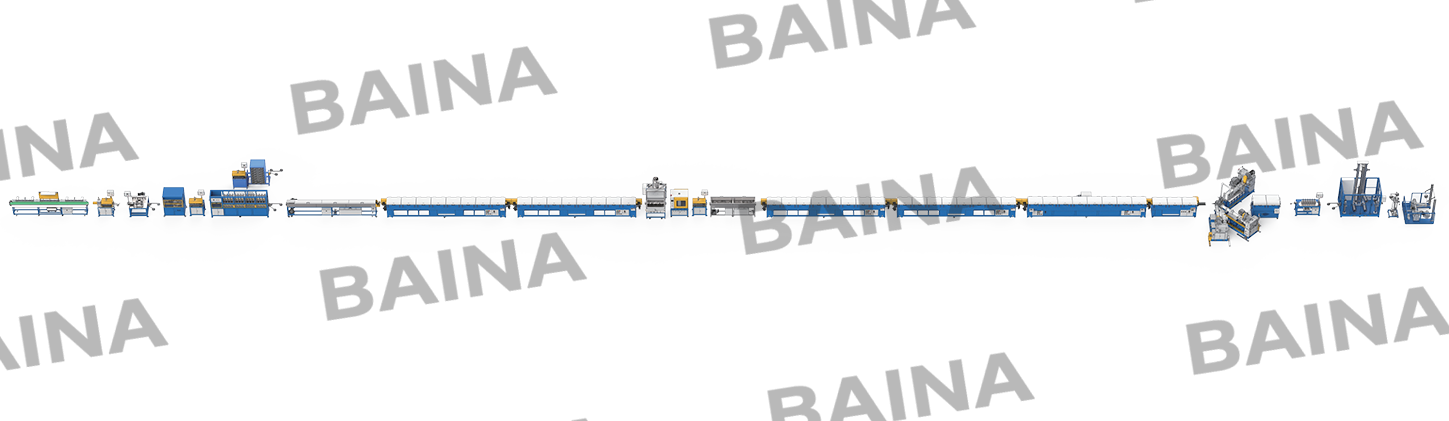
Specifying a China Door Seal Co-Extrusion Line with UHF: Material Options and Microwave Curing Advantages
What Materials Can Be Co-Extruded on a Door Seal Production Line?
A co-extrusion line for door seals uses two or more extruders feeding a single die head to produce a profile with different materials in distinct zones—typically a dense rubber base for structural attachment and a soft sponge rubber sealing lip for compression.
The material pairings that actually work
Not every rubber bonds to itself during co-extrusion. The critical requirement is chemical compatibility during the uncured state so that the interface fuses rather than delaminates. Below are the proven combinations on Chinese-made co-extrusion lines (often branded as "door seal rubber co-extrusion and curing production line UHF").
Co-Extrudable Material Pairings
|
Material A |
Material B |
Bonding Method |
Typical Application |
UHF Compatibility |
|
Dense EPDM |
Sponge EPDM |
Chemical (same polymer) |
Automotive weatherstrip |
Excellent |
|
Dense EPDM |
TPV |
Interfacial crosslinking |
Visible trunk seals |
Good (tuning required) |
|
Silicone |
Silicone (different durometer) |
Chemical |
Medical door seals |
Moderate (silicone absorbs less UHF) |
|
EPDM |
Metal carrier |
Mechanical compression |
Freezer case seals |
Not applicable (inserted pre-cure) |
The practical limit: You cannot co-extrude natural rubber with EPDM. Their cure speeds differ by 3:1. The natural rubber will scorch before the EPDM begins crosslinking.
Microwave Curing – Advantages of UHF (Ultra-High Frequency) Curing
UHF curing (typically 915 MHz or 2,450 MHz) uses microwave radiation to heat rubber profiles from the inside out, rather than relying on conductive or convective heat transfer from the surface. The rubber's polar molecules—particularly carbon-black particles and certain accelerators—oscillate rapidly in the electromagnetic field, generating friction and volumetric heat.
Five specific advantages over conventional hot air curing
Rapid Temperature Rise (Seconds, Not Minutes)
Conventional hot air tunnels require 4–8 minutes to bring a 10mm-thick EPDM profile to cure temperature (160–180°C) because heat must conduct from the surface inward. UHF achieves the same core temperature in 30–90 seconds. Result: Shorter tunnel length (8–12 meters vs. 20–30 meters) and lower energy consumption per kilogram. Search signal: fast cure time UHF rubber extrusion line.
Uniform Core-to-Surface Curing
Hot air inevitably overcooks the profile's skin while waiting for the center to reach temperature. UHF heats volumetrically—the center and surface rise simultaneously. The outcome: consistent crosslink density through the entire cross-section. Dense EPDM seals show no brittle skin or under-cured core. Critical for door seals requiring 70+ Shore A hardness with consistent compression set.
Selective Heating Based on Material Composition
UHF preferentially heats materials with higher dielectric loss factors. In co-extruded dense + sponge EPDM, the dense section (higher carbon-black loading) heats slightly faster than the sponge (lower density, more voids). This compensates for the sponge's insulating effect. Without this selective heating, sponge sections would stay cooler and under-cure.
Energy Efficiency (40–60% Less Than Hot Air)
A 100 kW UHF tunnel produces approximately the same output as a 250 kW hot air tunnel. The physics: hot air heats the entire tunnel volume, the conveyor, and the surrounding air before touching the rubber. UHF only heats the profile itself. Search query: Energy-efficient UHF microwave curing for rubber profiles is a top procurement filter for European and North American buyers facing power cost pressures.
Reduced Scale and Floor Space
A complete co-extrusion line with UHF curing fits into 25–30 linear meters. A comparable hot air line needs 50–60 meters. For factories with leased space or multi-line layouts, this matters significantly.
UHF (Microwave) vs. Hot Air vs. Salt Bath Curing
|
Parameter |
UHF Microwave |
Hot Air Tunnel |
Fluidized Salt Bath |
|
Heat transfer mechanism |
Dielectric (internal) |
Convection (external) |
Conduction (contact) |
|
Typical cure time (10mm EPDM) |
60 seconds |
6–8 minutes |
90 seconds |
|
Energy cost per kg rubber |
Low (0.3–0.5 kWh/kg) |
High (0.8–1.2 kWh/kg) |
Medium (0.5–0.7 kWh/kg) |
|
Surface finish quality |
Excellent (smooth) |
Good (slight oxidation possible) |
Poor (salt residue requires washing) |
|
Equipment cost (100 kW line) |
$$$ (high initial) |
$$ (moderate) |
$ (lowest initial) |
|
Operating cleanliness |
Clean (no emissions) |
Clean (exhaust required) |
Dirty (salt disposal, corrosion) |
|
Best application |
Automotive weatherstrip, co-extruded profiles |
Thick solid profiles (>20mm) |
Round hose, simple shapes |
The UHF limitation you must know: Silicone rubber has a low dielectric loss factor. It does not heat efficiently in standard 2.45 GHz UHF fields. For silicone door seals, you need either hot air complement (hybrid line) or a higher frequency (5.8 GHz, which is rare in production). Always ask: Can this UHF line cure silicone seals before buying?
Final note on Chinese-made UHF lines: The microwave generators (magnetrons) are often repurposed from industrial kitchen or drying equipment. Reliable suppliers use magnetrons rated for continuous industrial duty (8,000+ hours), not the 2,000-hour consumer-grade units. Search for a China UHF curing line if longevity is your priority.
-

-
No. 18, Chunhui Est. Rd., Yong’An Ind. Area, Xianju, Taizhou, Zhejiang, ChinaRoom 707, Building 1, Baolong Plaza, Hangzhou Sci-Tech City, Yuhang District, Hangzhou, Zhejiang, China+86-576-87685299
+86-571-89059793+86-576-87685311 - Home Machinery&Solutions About Baina Industry Applications Support Info Contact Us
-
Copyright © 2025 by Zhejiang Baina Rubber & Plastic Equipment Co., Ltd. All Rights Reserved.

China Rubber Extruder