




Rubber Salt Bath Curing Production Line(LCM) Factroy
Baina’s Salt Bath (LCM) vulcanization line uses a liquid salt medium for uniform and rapid heat transfer, providing products with excellent surface finish. The system adopts a modular segmented design (e.g., free spray zone, roller conveyor zone) and integrates an efficient vibrating puller and automatic salt recovery system. It guarantees production speeds as high as 80 meters/minute while achieving low energy consumption and minimal salt usage, making it an ideal choice for products like wiper blades and high-end seals.
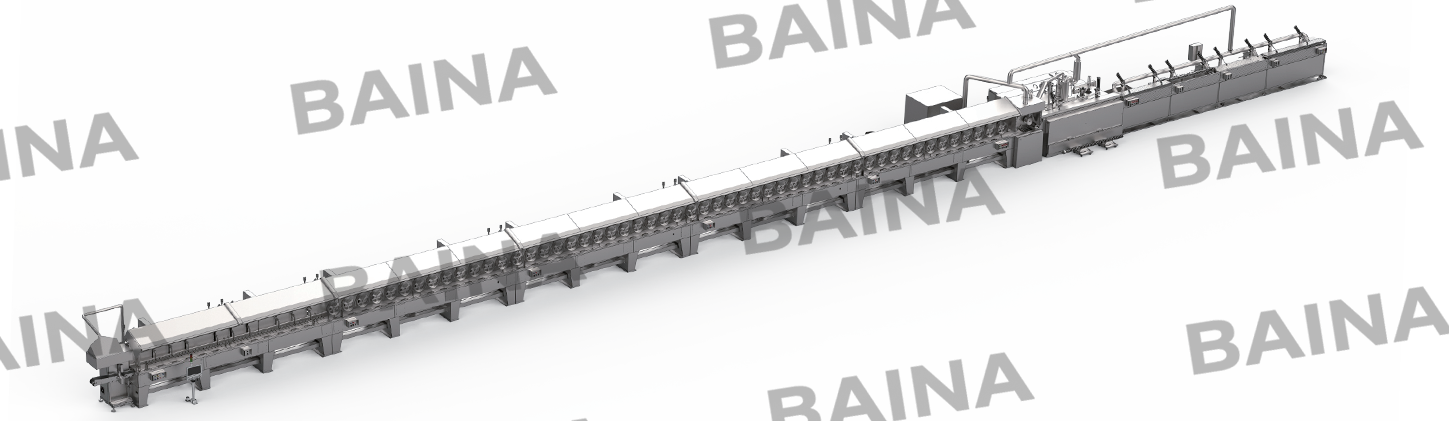
Thermal Efficiency vs. Operational Drag: Assessing the Rubber Salt Bath Curing Production Line (LCM)
What a Liquid Cure Medium (LCM) Salt Bath Line Actually Is
A rubber salt bath curing line (LCM) is a continuous vulcanization system where extruded rubber profiles pass through a heated molten salt mixture—typically a eutectic blend of potassium nitrate, sodium nitrate, and sodium nitrite—maintained at 190–230°C. The salt transfers heat via direct contact conduction, raising the rubber to cure temperature in seconds rather than the minutes required by hot air tunnels.
Why efficiency claims need qualification
Search engine queries like rubber salt bath curing line efficiency or LCM line energy consumption per kg often return vendor claims of "90% thermal efficiency." That number refers to heat transfer from salt to rubber—and it is accurate. Direct contact conduction is exceptionally efficient. A 10mm EPDM profile reaches 180°C core temperature in 45–60 seconds inside a 6-meter salt bath. The same profile takes 5–7 minutes in a 25-meter hot air tunnel.
However, plant managers searching for salt bath curing line operating cost quickly discover that thermal efficiency is only half the equation. The other half involves parasitic losses that do not exist in UHF (microwave) or hot air systems.
Three specific efficiency metrics that actually matter:
- Line speed capability: Salt bath lines routinely run at 15–25 meters per minute for medium-profile door seals. Hot air tops out at 6–10 m/min for comparable cross-sections.
- Salt-to-rubber heat transfer coefficient: Approximately 800–1,200 W/m²K in agitated molten salt versus 50–150 W/m²K in forced hot air.
- Energy to maintain molten state: The bath consumes 15–25 kW continuously, even when no rubber is passing through—just to keep the salt from solidifying (melting point typically 140–160°C).
The efficiency paradox: If your line runs 24/7 with minimal gaps, LCM is the energy-efficient continuous cure method per kilogram of rubber. If your line stops frequently for die changes or shift breaks, the standing loss erodes the advantage.
Three Production Environments Where LCM Excels or Fails
High-volume automotive weatherstrip (Excellent fit)
A tier-one supplier runs three LCM lines 20 hours per day, six days per week, producing dense and sponge EPDM profiles for door seals. Line speed: 22 m/min. Annual output: 1,800 metric tons. Efficiency outcome: Salt bath curing achieves 0.38 kWh per kg of cured rubber—significantly lower than the 0.55–0.65 kWh per kg typical of UHF lines at this volume. The key phrase is high volume rubber extrusion equipment with salt bath curing – manufacturers design dedicated LCM cells around this scenario.
Job shop with frequent product changeovers (Poor fit)
A custom profile extruder runs six different profiles per day. Each change requires:
Draining and refiltering the salt bath (25 minutes)
Re-establishing thermal equilibrium after salt-level changes (15 minutes)
Flushing the previous rubber residue from the salt (continuous over the first 50 meters of the new run)
Result: Effective line speed drops to 8–10 m/min when accounting for downtime. The salt bath curing line for small batch rubber extrusion search query returns few results because LCM simply does not suit this use case.
Silicone tubing for medical devices (Dangerous – do not use)
Silicone rubber absorbs molten nitrite salts at high temperatures. The resulting cross-contamination fails USP Class VI biocompatibility testing. Any extruder searching for a medical-grade silicone curing line should immediately exclude LCM options. Use hot air or platinum-catalyzed UHF instead.
Salt Bath LCM vs. UHF Microwave vs. Hot Air
|
Parameter |
Salt Bath (LCM) |
UHF Microwave |
Hot Air Tunnel |
|
Heat transfer efficiency |
85–90% (conduction) |
55–65% (dielectric) |
35–45% (convection) |
|
Line speed (10mm EPDM) |
18–25 m/min |
10–18 m/min |
5–8 m/min |
|
Energy consumption (kWh/kg) – steady state |
0.35–0.45 |
0.50–0.70 |
0.90–1.20 |
|
Energy consumption – intermittent stops |
Much higher (+40–60%) |
Slightly higher (+10–15%) |
Moderate (+20–25%) |
|
Surface finish quality |
Excellent (smooth, glossy) |
Very good |
Good (slightly oxidized) |
|
Post-cure cleaning required? |
Yes (water wash removes salt residue) |
No |
No |
|
Equipment cost (complete line) |
$$ (moderate) |
$$$ (high – magnetrons) |
$ (lowest) |
|
Best-suited extrusion output |
Continuous high volume |
Medium volume, mixed profiles |
Low volume, thick sections (<15mm) |
The two minor issues (as requested):
Minor Issue 1 – Salt residue handling is not trivial. The cured profile exits the bath coated in a crystalline salt film. Downstream washing stations (high-pressure spray, 50–70°C water) remove 95–98% of it. The remaining 2–5% embeds into surface voids of sponge rubber profiles. For visible automotive seals (e.g., trunk weatherstrips visible to the end customer), this requires an additional brushing station. Search for how to remove salt residue from cured rubber extrusion is a common technician query – the industrial answer is a three-stage wash (hot rinse, ambient rinse, forced air dry).
Minor Issue 2 – Salt bath maintenance consumes skilled labor hours. The salt mixture gradually absorbs rubber oils, carbon-black fines, and processing aids. Every 400–600 operating hours, the line must be shut down for full salt draining, filtering, or replacement, and crucible inspection. This is a 6–8 hour process. In comparison, a UHF line's magnetron replacement takes 45 minutes. Plant managers comparing rubber extrusion equipment maintenance cost LCM vs UHF find that LCM has lower consumables cost (salt is cheap) but higher labor cost for maintenance windows.
Minor Issue 3 (bonus) – Sponge rubber density control is finicky. The high thermal conductivity of molten salt means the blowing agents in foamable EPDM activate extremely quickly. This produces very fine, closed-cell foam with compression set – desirable for seals. However, if line speed fluctuates by more than ±5%, the sudden temperature spike causes irregular cell collapse. Operators need active line speed control tied to salt temperature sensors.
Final verdict for procurement: Choose a rubber salt bath curing production line (LCM) when you have:
- A single high-volume EPDM profile running 16+ hours per day
- Dedicated operators trained in salt chemistry handling
- Downstream washing and drying stations already in place
- No silicone or medical-grade production in the same facility
-

-
No. 18, Chunhui Est. Rd., Yong’An Ind. Area, Xianju, Taizhou, Zhejiang, ChinaRoom 707, Building 1, Baolong Plaza, Hangzhou Sci-Tech City, Yuhang District, Hangzhou, Zhejiang, China+86-576-87685299
+86-571-89059793+86-576-87685311 - Home Machinery&Solutions About Baina Industry Applications Support Info Contact Us
-
Copyright © 2025 by Zhejiang Baina Rubber & Plastic Equipment Co., Ltd. All Rights Reserved.

Rubber Extrusion Equipment