




Butyl Rubber Extrusion Production Line
Baina's butyl rubber extrusion line is specifically designed for processing butyl rubber, known for its excellent air tightness, water tightness, and aging resistance. Optimized for the processing characteristics of butyl rubber, such as high viscosity and low self-adhesion, this line ensures stable extrusion and precise molding of the compound. It is an ideal solution for producing high-performance sealing strips and waterproofing materials.
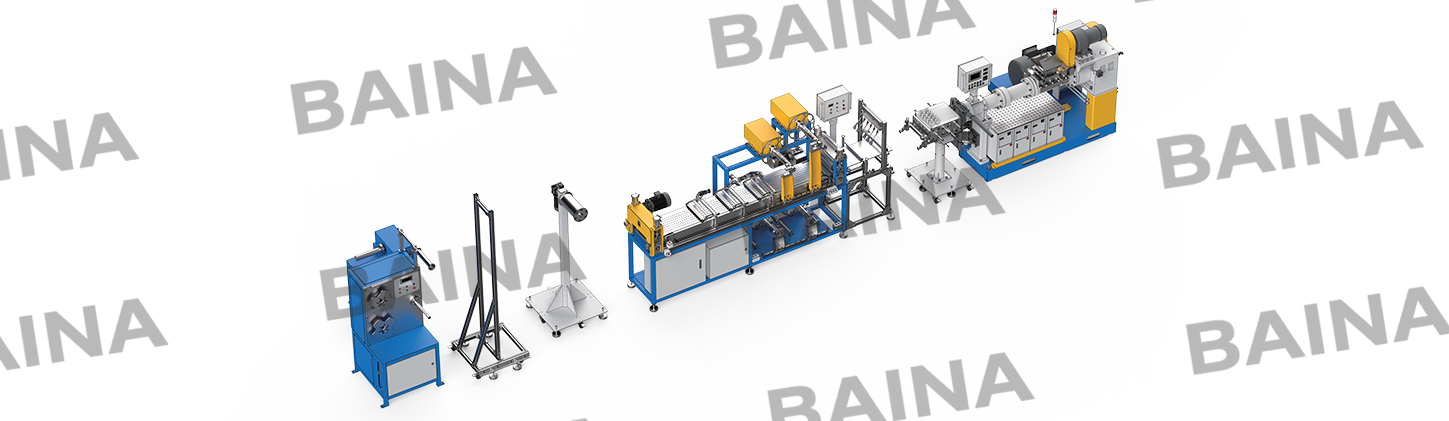
Processing the Airtight Polymer: A Technical Guide to the Butyl Rubber Extrusion Production Line
Butyl Rubber Extrusion Production Line – Suitable Products and Current Technological Trends
A butyl rubber extrusion production line is a continuous manufacturing system specifically designed to handle polyisobutylene-based (IIR) compounds. Unlike EPDM or natural rubber lines, butyl equipment must address the material's unique challenges: high damping (energy absorption), low green strength (tears easily before cure), and exceptional gas impermeability—roughly 8–10 times lower oxygen transmission than natural rubber.
Standard rubber extrusion lines pull uncured profiles through curing sections using belt haul-offs or rollers. Butyl's low green strength means it stretches and tears under the same tension that works fine for EPDM. Consequently, butyl rubber extrusion production line designs incorporate shorter draw distances, more support rollers, and tension feedback loops.
What products are it suitable for?
Butyl extrusion targets applications where airtightness or vibration damping matters more than abrasion resistance or high-temperature stability. The specific product categories include:
- Inner liners for tubeless tires: A 1–2mm butyl layer inside a tire carcass holds air. The extrusion line produces a wide sheet (800–1,600mm) that gets spliced into tire building drums. Search query: butyl inner liner extrusion line for tire manufacturing.
- Pharmaceutical stoppers and syringe plungers: Medical-grade butyl (brominated or chlorinated for cleanliness) extrudes into rod or tube form, then slugs are cut and compression-molded into stoppers. The extrusion line must include HEPA filtration and metal detection.
- Sealant tapes and glazing butyl: Self-adhesive butyl tapes for window installation, RV roof sealing, or automotive sound deadening. The line combines extrusion of a butyl ribbon (3–20mm wide) with silicone-coated release paper lamination. Search intent: butyl glazing tape extrusion line with liner applicator.
- Vibration control pads: Dense butyl sheets (2–10mm thick) cut into machinery mounting pads or speaker gaskets.
What are the current technological trends?
Trends in butyl extrusion focus on overcoming the material's low green strength and enabling new applications.
Short-path, low-tension haul-off systems
Legacy lines used pneumatic pinch rollers. Newer butyl rubber extrusion line designs use servo-driven caterpillar haul-offs with independent tension control per track. The result: butyl profiles with wall thickness as low as 0.8mm without tearing—previously impossible.
In-line calendering for wide sheet
Extruding butyl sheet wider than 600mm causes edge tearing due to uneven flow distribution. The emerging solution: a wide slot die extrudes a rough sheet (over-thick by 30–50%), then immediately enters a three-roll calendar for final gauging. The rolls support the sheet's weight, preventing sag tears. Search query: butyl sheet extrusion with in-line calendar for inner liner is growing.
Cold-feed with barrier screw geometry
Butyl is highly shear-sensitive. Over-shearing in the screw causes molecular breakdown and tackiness loss. New screw designs feature shallow feed depths (12–15mm) and longer metering sections (8–10 flights) to homogenize temperature without excessive shear. These are marketed as low-shear butyl extruder screw for pharmaceutical grade.
Continuous vulcanization alternatives
Historically, butyl was cured in autoclaves (batch) because its slow cure rate made hot air tunnels impractical. Microwave (UHF) works poorly on butyl (low dielectric loss). However, LCM (salt bath) continuous curing adapted for butyl now runs at 5–8 m/min—slower than EPDM salt bath (15–25 m/min) but continuous, not batch. Early adopters search for butyl salt bath curing line for continuous stopper production.
Butyl vs. EPDM Extrusion Line Requirements
|
Parameter |
Butyl Line |
EPDM Line |
|
Tension control |
Critical (low green strength) |
Moderate |
|
Screw design |
Low-shear, shallow feed |
Standard or high-shear |
|
Continuous curing method |
Salt bath (preferred) or autoclave |
Microwave hybrid or hot air |
|
Typical line speed |
3–8 m/min |
8–20 m/min |
|
Key search signal |
low tension butyl extrusion line for inner liner |
high-speed EPDM weatherstrip line |
Different Types of Rubber Extruders
A rubber extruder is a screw-driven machine that converts solid rubber compound (strip, slab, or pellet) into a continuous, shaped profile by forcing it through a die under heat and pressure. Rubber extruders only warm and plasticize the compound without completely melting.
Type 1: Cold-Feed Extruders (The Modern Standard)
How it works: Room-temperature rubber strip (typically 25–30°C) enters the feed hopper. The screw (L/D ratio 12:1 to 16:1) compresses and shears the compound, raising its temperature to 80–110°C before the die.
Advantage: No separate warming mill needed. One operator runs the line.
Use case: Most general-purpose extrusion—weatherstrips, hose, tubing. Search query: cold feed rubber extruder for EPDM profiles.
Subtype: Vacuum cold-feed extruders have a vented barrel section that removes trapped air, preventing bubbles in the final profile.
Type 2: Hot-Feed Extruders (Legacy, Still Specialized)
How it works: A two-roll mill pre-warms rubber to 70–90°C, then feeds the hot strip into a short-barrel extruder (L/D 4:1 to 8:1). The screw primarily conveys rather than shears.
Advantage: Lower shear heating, preserves heat-sensitive compounds. Used for tire treads and large profiles where cold-feed would scorch the material surface.
Search signal: hot feed rubber extruder for tire tread application.
Type 3: Pin-Type (Vented) Extruders
How it works: Retractable metal pins protrude into the screw channel, repeatedly folding the rubber. Vacuum ports connected to pin sections remove volatiles (moisture, trapped air, low-molecular-weight oils).
Use case: Sponge rubber profiles (where bubbles would ruin cell structure) or recycled rubber compounds containing contaminants.
Search query: pin barrel rubber extruder for void-free sponge profile.
Extruder Types
|
Feature |
Cold-Feed |
Hot-Feed |
Pin-Type Vented |
|
L/D ratio |
12:1 to 16:1 |
4:1 to 8:1 |
14:1 to 18:1 |
|
Feed material temperature |
Ambient (25–30°C) |
Pre-warmed (70–90°C) |
Ambient or warm |
|
Operator skill required |
Moderate |
High (mill operation) |
Moderate |
|
Best application |
General profiles, hose |
Tire tread, thick sections |
Sponge rubber, recycled compounds |
-

-
No. 18, Chunhui Est. Rd., Yong’An Ind. Area, Xianju, Taizhou, Zhejiang, ChinaRoom 707, Building 1, Baolong Plaza, Hangzhou Sci-Tech City, Yuhang District, Hangzhou, Zhejiang, China+86-576-87685299
+86-571-89059793+86-576-87685311 - Home Machinery&Solutions About Baina Industry Applications Support Info Contact Us
-
Copyright © 2025 by Zhejiang Baina Rubber & Plastic Equipment Co., Ltd. All Rights Reserved.

Rubber Extruder For Sale